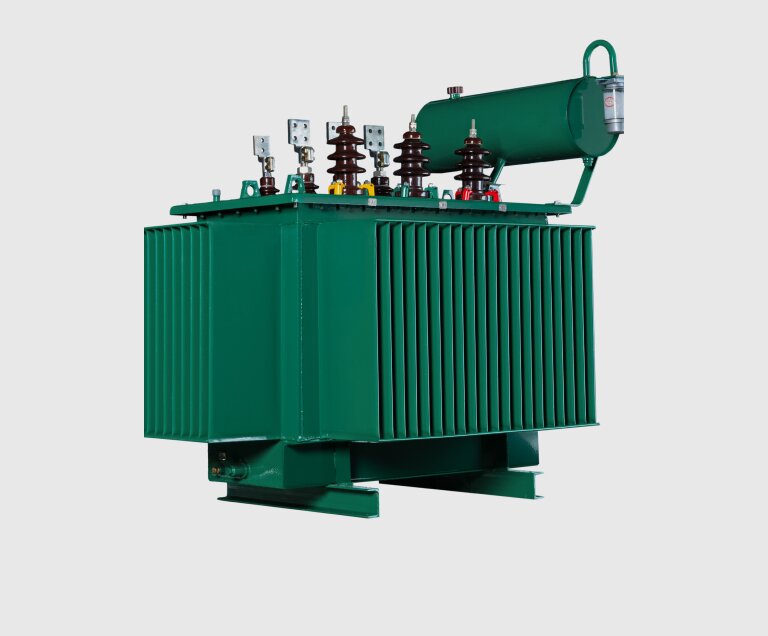
TYPE DESIGNATION
The model number tells you exactly what you are ordering. Take S11-M-500/10 as an example:
• S means three phase
• 11 is the design series and energy efficiency level
• M stands for hermetically sealed
• 500 is the rated capacity in kVA
• 10 is the high voltage side in kV
If you see a D prefix, the unit is single phase.F means forced-air cooling is added.C indicates an on-load tap changer.R refers to round (core) core construction.
S13 series follows the same naming rules but meets a higher energy efficiency grade with lower no-load and load losses. When your project specification calls for the latest national energy efficiency standards or when the transformer will run at light load for long hours, S13 is the better fit.
STRUCTURAL DESIGN
CORE
The core is stacked from cold-rolled grain-oriented silicon steel laminations, cut at 45-degree mitered joints to reduce flux leakage at the corners. Laminations are coated with insulating film and clamped with steel structural parts. This clamping design also controls core vibration and keeps operating noise down.
WINDINGS
• High voltage windings use multi-layer cylindrical construction with oxygen-free copper wire or electrical aluminum wire.
• Low voltage windings use foil winding or layer winding depending on the current rating.
• All windings go through vacuum drying and vacuum oil impregnation to remove moisture and air pockets from the insulation.
TANK
• Hermetically sealed units use corrugated tank walls that expand and contract with oil temperature changes. No conservator, no breather, no oil-air contact.
• Conservator type units have a separate oil expansion tank with silica gel breather for oil preservation.
S11 VS S13 LOSS COMPARISON
The table below shows typical no-load and load loss values for common capacity ratings. S13 series delivers measurably lower losses at every capacity point. Over the 20–30 year service life of a distribution transformer, the accumulated energy savings from reduced iron and copper losses can be significant — especially for units that stay energized around the clock.
| Capacity (kVA) | S11 No-Load Loss (W) | S13 No-Load Loss (W) | S11 Load Loss (W) | S13 Load Loss (W) |
|---|
| 100 | 200 | 160 | 1,500 | 1,350 |
| 315 | 460 | 380 | 3,500 | 3,150 |
| 500 | 680 | 555 | 4,900 | 4,400 |
| 1,000 | 1,200 | 980 | 10,300 | 9,200 |
| 2,500 | 2,600 | 2,100 | 21,500 | 19,200 |